

I’m preparing to teach a class for Whatcom Community College on the amphibians of Northwest Washington–and in preparing for it, I’ve been reminded of what a fantastical group of creatures the class Amphibia represents. They may not be as large and physically impressive as mammals, or as readily visible as birds, but amphibians have some of the most intriguing life histories and behavior patterns of any group of animals in the Northwest.
For purposes of the PNW, our amphibian species can be divided into two groups: frogs and toads in one, salamanders and newts in the other. Of the former, the species you’re perhaps most likely to see is the Pacific tree frog, or Pacific chorus frog, a small green or brown frog often found at rest on the leaves of trees or shrubs near bodies of fresh water. These are also our most vocal native frogs, who bring the night alive with song around ponds in the spring.

Then there’s red-legged frogs, the medium-sized brownish frogs found in creeks and wetlands, which are often seen jumping away from your footfall as you approach. The other major frog-or-toad species in Northwest Washington is the western toad–a large, stocky amphibian with bumpy skin that’s sometimes found hiding under clumps of vegetation far from water. Venture up into the North Cascades and you might encounter spotted frogs, Cascades frogs, and leopard frogs.
Salamanders and newts (which are really just a type of salamander) can be subdivided into two categories: aquatic salamanders, whose larval stages have gills and live in water; and fully terrestrial salamanders, whose eggs hatch into juveniles that resemble miniature adults. Two common species in this region, the ensatina and the western red-backed salamander, belong to the latter category. Both are commonly found under decaying logs on the forest floor after a rain.
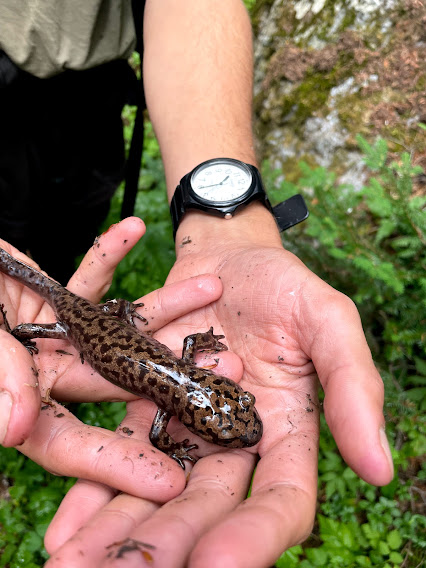
Aquatic salamanders, like all our local frogs and toads, actually have both an aquatic and a terrestrial life stage. Species in this category include the Northwestern salamander, the adult stage of which burrows underground usually comes to the surface only at night. Then there’s the long-toed salamander, and the huge Pacific giant salamander–which you’re most likely to find in mature forests with lots of big logs on the ground.
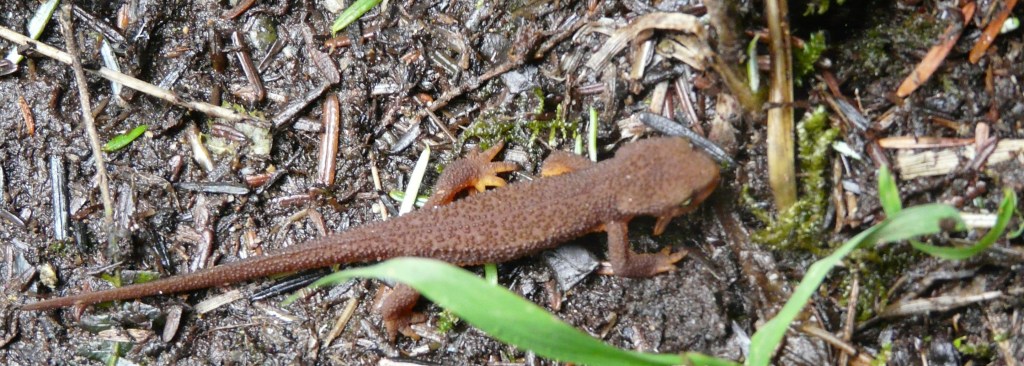
We have one local species of newt, which is a type of aquatic salamander. Rough-skinned newts are among the amphibian species you’re most likely to find in the wild, as they can commonly be found wandering in the open on the forest floor after rain. Their boldness may be attributed to the fact that they’re extremely poisonous, to both animal predators and people. Rough-skinned newts spend the fall and winter mostly on land, migrating to ponds and slow-moving creeks in spring, where they gather in large groups to mate. A pond full of dozens newts undulating gently around each other is a striking sight and one of the most surreal phenomena spring in the Northwest has to offer.
What intrigues me most about amphibians is how delicate they are, both in their physical form and the trajectory of their life histories. Many amphibians rely on seasonal ponds, clear streams, or other sensitive environments for all or part of their lifecycles. Some require mature forests for habitat. And, their permeable skin–which can absorb oxygen from both air and water–makes them highly susceptible to pollution and environmental disturbance. It’s no wonder they are among the most endangered groups of animals.
Every time I see a healthy amphibian in its native habitat, I feel reassured to know the local ecosystem is still healthy enough to support some of these incredible creatures. I hope this continues to be the case into the indefinite future–both in my home region of the Pacific Northwest, and beyond.
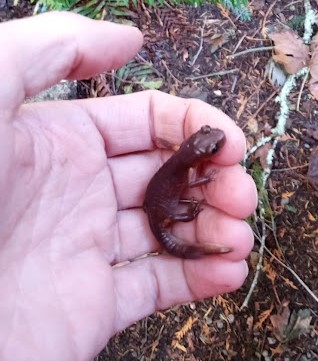
Note: As you can see from the photos, I’m fond of picking up amphibians–especially when showing them to groups of students for educational purposes. However, these fragile animals should be handled very gently, and only for short lengths of time. Don’t allow their skin to dry out in the exposed air, and don’t handle them at all if you have sunscreen, bug spray, or other substances on your hands.
Top photo: a rough-skinned newt in Boulder River Wilderness Area.
 Nick Engelfried
Leave a comment