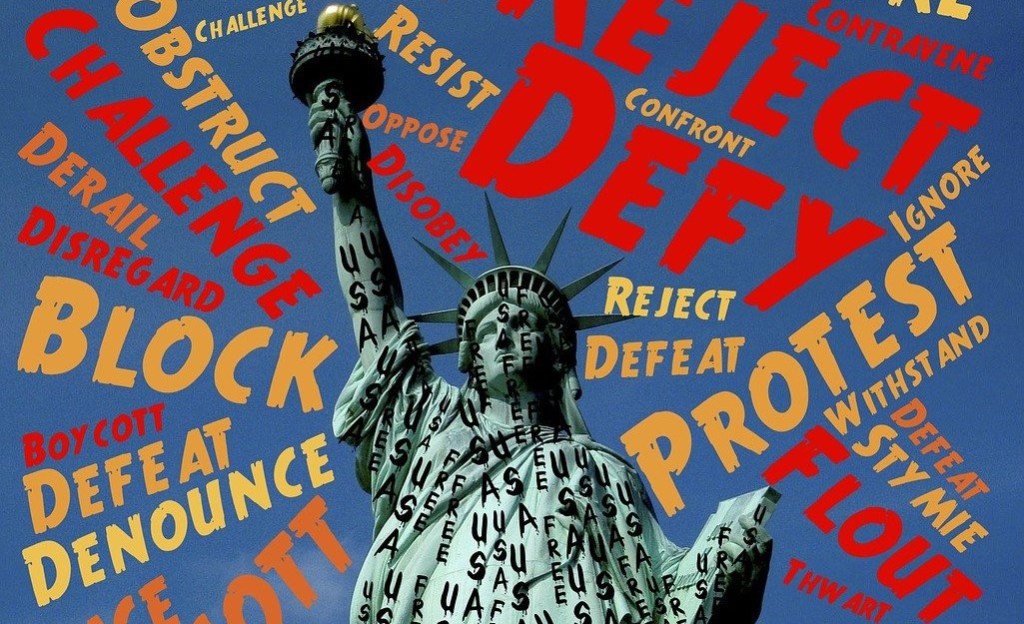


Today seems like a good day to consider how progressives and people who truly care about US democracy can resist the incoming second Trump administration. It’s clear that many thousands, maybe millions of people are eager to stand up to Trump’s assault on elected government, human rights, and the global climate. However, what’s clear for many folks is how to go about actually doing this effectively. Below are some suggestions based on my almost two decades of experience participating in, teaching about, and writing about grassroots movements.
Join a protest
Effectively organized in-person, on-the-ground protests remain one of the most important–and perhaps the single most important–way to put a focus on the moral stakes involved in any activist campaign. The reason is simple: protests are visible and attention-grabbing (when done strategically), and they show a level of commitment on the part of activists that’s several steps above signing a petition or posting on social media. Participating in a protest requires time, energy, and perhaps even the willingness to take risks–and precisely because of this that it gets elected officials’ attention. When hundreds or thousands of people take to the streets in protest, it helps show the degree to which large numbers of people care enough about exercising their democratic rights.
There will doubtless be many opportunities to join and organize protests against the Trump administrations–but the first really big one is coming up on Jan 18, when organizations involved in the Women’s March movement are organizing massive protests in major cities (it’s being billed as more of a “People’s March” this year, with a broad focus on protecting democracy). Find a march near you and RSVP.
Call or write your member of Congress
Whether you’re represented by Republicans or Democrats in the US House and Senate, your elected federal representatives need to know you oppose the policies of the Trump administration. The degree to which they hear from constituents will likely determine how much Republicans in Congress go along with the administration’s more extreme plans, and how hard Democrats fight against those same policies. If you don’t know how to contact your representatives, it’s easy to find their contact information using this site. Then, make a call to their office or write them an email.
Note that while many advocacy organizations provide template emails you can use to send your representatives, writing a personalized email is always better. Even if it’s short, a personalized message shows you took the time to understand what’s at stake and share your own thoughts, rather than just copying someone else’s message, and it will result in your words being given more weight.
Get involved in state and local politics
Many important policy decisions happen not in Congress or the White House, but in state legislative chambers and city councils–and, depending on where you live, it might be genuinely possible to create positive, progressive change at the state or local level. Find out the names of your state legislators, city or town council member, and local county commissioner, and contact them by phone or email. These messages can be even more impactful than those sent to members of Congress; since state and local officials receive fewer phone calls and emails overall, each one they do get sends an especially strong message.
Help elect better politicians
Wherever you live, there is likely some type of election happening in 2025–whether it’s for City Council, the school board, or special state or federal election. If you live in a place like Virginia or New Jersey, you even have a chance to vote in regular elections that will determine who controls the state legislature and Governor’s office. So, find out what progressives are running for office and volunteer to knock on doors for their campaigns. Most serious campaigns will have easy ways to plug in and get involved, even if you have no prior political organizing experience.
Of course, if you have the means you can also donate to candidates who share your values–and even small donations go a long way. In this day and age, the number of small donations a candidate receives doesn’t just help them build an election war chest–it also sends a message about the level of support they have from the community. Even if you can just give $10 to your preferred candidate, it’s worth making the contribution.
Use social media strategically
For better or worse, social media platforms play an increasingly important role in shaping public perceptions and the national conversation about key issues–whether you’re most concerned about climate change, the right to choose, or preserving democratic values themselves. Posting on social media shouldn’t take the place of other types of activism, but when used to complement on-the-ground organizing efforts, it can be incredibly effective. So, choose a platform and use it to make your voice heard.
What platform you use to spread your message is itself a political choice, as shown by the mass exodus of people away from “X” in the aftermath of last November’s election. Platforms like X are increasingly used by the country’s elite to spread misinformation and hate, and it’s important that they feel some pain for doing so by losing support. Bluesky Social embodies all the best things about X–or Twitter as it used to be known–and has real safeguards in place to limit the spread of misinformation and conspiracy theories. That’s why I’ve made it my main social media platform.
In conclusion
Whether by joining a protest, contacting your federal, state, or local representatives, volunteering on behalf of a candidate, all progressives can play a role limiting the harm done by the next Trump administration while simultaneously building momentum for true progressive policies. In fact, hopefully you’re doing at least two or three of the things on this list, and if not then now is a great time to start! It’s going to be a rough four years–but with a strong resistance movement, we can make sure no Trump policy goes unchallenged.
Want more ideas for making positive change? Check out my earlier posts, Five Effective Ways to Take Action on Climate Change and So You Think You Voted?
Photo: Johnhain on Pixabay
 Nick Engelfried
Leave a comment