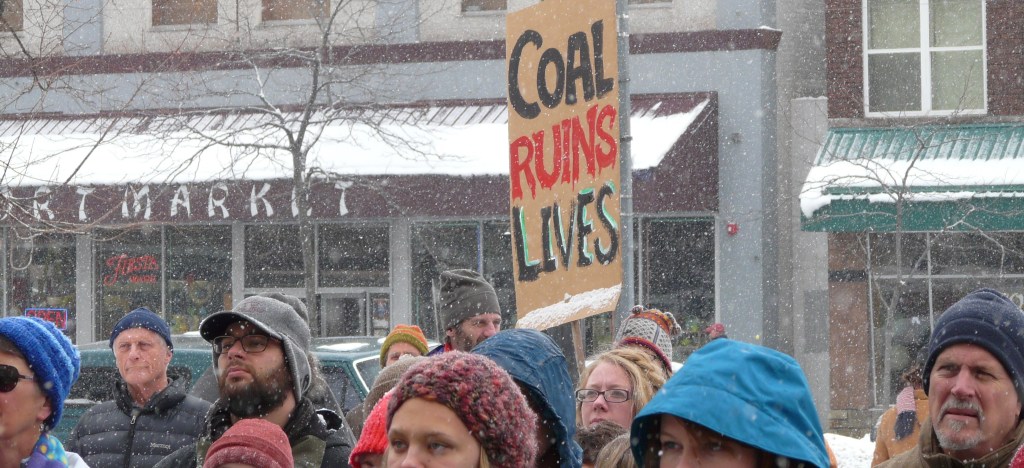


Banner image: A photo I took in Missoula, MT years ago that helped document the growing resistance to coal train traffic.
Being an activist in the United States is more dangerous than it used to be. The expansive growth of social movements for racial justice, climate action, gender equity, and much more has provoked a backlash from the forces of empire who seek to quell dissent–most obviously through the ascent of the second Trump administration. Trump and his minions have said explicitly they will try to punish people who speak out in favor of views they disagree with. It’s therefore understandable that many activists are on edge.
That said, the current trend among activists toward advising people not to take pictures at protests–for fear of political retribution–is, I believe, severely misguided and counterproductive.
The argument against picture-taking is certainly well intentioned, the idea being that taking photos and posting them online could result in individuals being identified and targeted for punishment in some way. However, there are ways to greatly reduce or eliminate these risks without refraining from taking any photos. And, we have to consider just how important documenting events through images is in today’s internet age.
To put it bluntly: in today’s media environment, a protest that isn’t documented through photos may almost as well not have happened at all. Most protests have their biggest impact not through making a direct impression on passersby (though that certainly helps), but by being seen afterwards in the news or on social media. Given how important visual imagery is in today’s media, a protest that isn’t preserved through photos will have very little impact on public perceptions of the issue its organizers hope to influence.
Are there genuine risks associated with participating in and being seen at protests? Yes. This has always been the case, although it’s more true now. It’s also true that some people–undocumented immigrants, for example–are much more vulnerable to retribution than others. However, if you are so concerned about possible ramifications from your presence at a protest being known that you are unwilling to take the risk of being recognized in a photo, there’s an obvious solution: don’t go to protests, and make your voice heard in other ways.
The above suggestion is not facetious. For some individuals, especially those from marginalized backgrounds, not participating in public protest may genuinely be the right move at this moment in history. At the same time, it’s equally true that protests are important. The image of crowds standing or marching in the streets has an impact on policymakers and the public that can’t be readily duplicated any other way. Protest is an essential tool for dissent, now more than ever. If you feel able to do so, you absolutely should participate in public protest when the opportunity arises–all the more because this option may be unavailable to some people. And, the possibility that you might be recognized in a photo is one of the risks you inherently accept in choosing to take this step.
That said, it is certainly true that we should be selective when taking photos at protests, and respect the desires of others who may want to minimize their risk of exposure. Here are some simple ways to do this:
Take crowd shots that don’t clearly show faces. A photo that shows a sea of bodies and signs, but which is zoomed out enough or taken at an angle where individual features can’t be made out, can do an excellent job showing the scale of a protest without identifying people.
Ask before clicking. If you would like to take a photo where individuals may be identifiable, make sure you first ask anyone who might appear in it whether they are okay with this happening. This is a very simple way to ensure you’re not photographing people who desperately want to avoid having their presence documented.
Take selfies. If you don’t belong to an identity that’s at heightened risk yourself, take a picture of yourself with your sign, and let that be your documentation of the protest.
My point here is not to downplay or minimize the genuine risks that can come with participating in acts of protest. There can be ramifications, which is partly why protest is so impactful as a tool for dissent. Hundreds or thousands of people stepping out of their comfort zones to do something that involves some level of risk communicates to onlookers that the issue they’re speaking out about is just that important. This explains why protest is so important in any social movement.
Participating in a protest inherently involves some level of sacrifice of personal comfort or safety–and for that sacrifice to be worth it, the protest needs to be documented in an effective way. To live in such fear of political retribution that we won’t risk being seen in acts of dissent means silencing our own voices, which equates to obeying in advance. Keep in mind that the powers of empire want us to be scared right now, and when we pre-emptively silence ourselves we are playing right into their hands.
So, by all means, let’s be smart about how we take photos at protests. And remember that for some people, not participating in this particular type of activism may genuinely be the right choice. But let’s not create an activist culture in which documenting dissent becomes taboo. If we let that happen, we might almost just as well not fight back at all.
 Nick Engelfried
Leave a comment