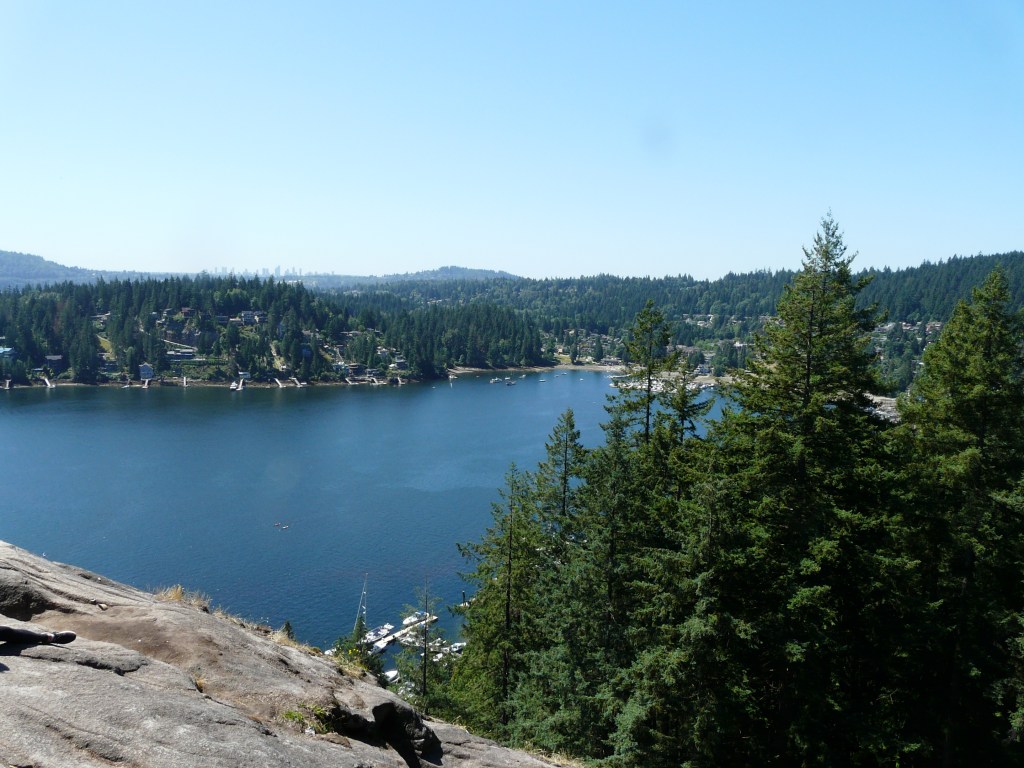


Image: a view of Burrard Inlet, just north of Vancouver, Canada
The first time I saw the US-Canada border, I found myself looking at a gash in the forest.
It was the early ’10s, and I was in Montana’s Yaak Valley, with other members of one of my grad school classes and our professor. We had wandered right up the international border, which was marked by a long, narrow clear-cut through the trees that extended to the east and west as far as I could see. It was a stark, not very ecologically sound way to demarcate the boundary between the two countries. I remember thinking it all seemed a bit unnecessary.
After all, people and animals have moved back and forth across the boundary separating what is now the US and Canada for countless millennia. The arbitrary imposition of a border by US and British authorities in the mid-1800s did little to stem this ebb and flow, and until recently this seemed like one of the relatively few international borders in the world that wasn’t likely to be marked by the kind of strife which plagues other politically drawn boundaries.
Now, as US-Canadian relations fray in a way that hasn’t happened in at least a century and a half, I hope that gash in that forest didn’t foretell the establishment of an even more ominous separation.
Years after wandering to the very edge of US territory in Montana, I had the opportunity to make multiple visits into Canada itself. The first time, it was to attend a protest against an oil pipeline being organized by Indigenous leaders in the Vancouver area. First Nations in this part of the continent were unceremoniously cut off from their relatives by the establishment of the border–but today, there is lots of great work being done by Indigenous folks on both sides of the boundary who are organizing for a better future.
As part of that visit to Canada, I hiked a trail near Deep Cove, just east of North Vancouver. I stood on a rocky cliff overlooking Burrard Inlet and took in a view of forested lands and mountains. Crossing the border into Canada a couple of days earlier had been stress-free, and now I stood near the bottom of the great stretch of wilderness that extends almost unbroken from southern BC, all the way up to the Yukon.
On that day not very many years ago, the idea of serious geopolitical tensions arising between the US and Canada would have seemed almost unthinkable. Today, though, it’s a reality. Suddenly, a future where both countries regard each other with suspicion and crossing the border becomes no longer a routine or simple affair seems very possible. It makes me think of a poem.
Decades ago, one of the Pacific Northwest great poets, William Stafford, set down in words a piece of writing that reminds us not to take the enduring peace between the US and Canada for granted. Like all great writers, Stafford was prescient enough to realize the world we live in rests on delicate foundations–and he sought to help people realize that peaceful relations between countries need to be actively fostered if they are going to continue. You can read the poem here.
I hope there will never be the need for a monument commemorating the people who fought bravely on either side of a military conflict between the United States and Canada. But for those of us who value peace, hoping isn’t enough. Let’s work actively to make sure the US-Canada border remains a boundary that, in Stafford’s words, future generations can continue to “celebrate…by forgetting its name.”
 Nick Engelfried
Leave a comment