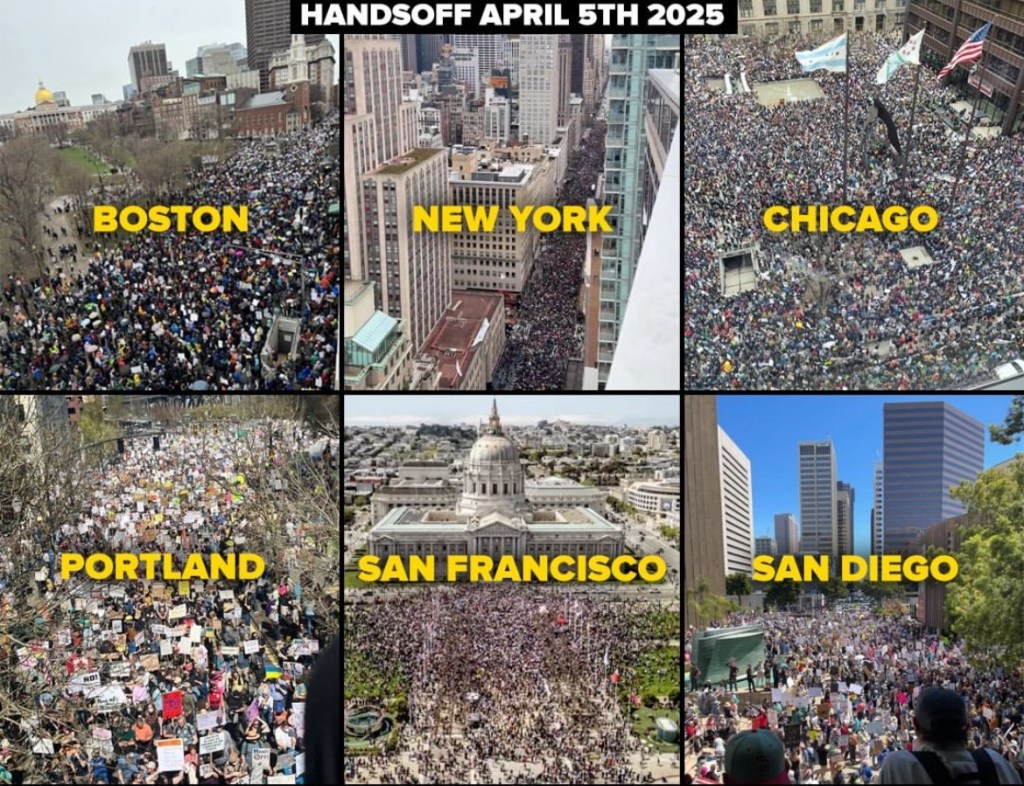


Image: protests across the country on April 5. Credit: Nick Knudsen via Bluesky (cropped from original image)
There’s a natural tendency among activists–understandable, though not always fair–to criticize the media. We don’t like how they cover our protests, how they portray our movements, or how gullibly they seem to swallow the arguments of our opponents. I remember railing against the media plenty of times in my early years as an activist.
These days, I’m more circumspect. Having worked on the media side of things myself, as an independent journalist, I have a better appreciation for how short-staffed most news outlets are and how little time reporters are given to cover complex, nuanced issues. I’ve come to believe that, when reporters who are basically well intentioned do what activists feel is a poor job covering their efforts, it’s not due to any dastardly conspiracy to purposefully suppress progressive voices. Rather, it’s a simple function of the fact that those of us who write about or otherwise cover important issues often don’t have time to conduct the kind of deep, investigative journalism those topics really deserve (note that I’m talking about decent people trying to do a fair job, not far-right media who intentionally twist reality to serve their interests and deserve every bit of criticism they get).
That said, there are some things about the mainstream media that never cease to confound me. Case in point: why is it that news stories are so consistently quick to judge protest movements as failures?
Almost without exception, nascent progressive social movements are judged much more harshly by the mainstream press than they’ll be remembered later–often by the very same publications. It happened with Civil Rights Movement of the 1960s and 70s, the global justice movement of the early 2000s, and the movement to stop tar sands pipelines in the 2010s. Most recently, it’s happened with the broad-based progressive resistance to the Trump administration.
When Trump was inaugurated earlier this year, mainstream media was quick to declare the “resistance” dead. Protests on Trump’s first day in office weren’t anything like the massive Women’s March actions of 2017, they noted, and progressive activist groups seemed exhausted. These observations weren’t incorrect. However, it’s a mistake to assume protest movements of today should look exactly as they did in the past–and rather than try to analyze how resistance to Trump might be taking a different form this time around, many in the world of media were happy to start writing the movement’s obituary.
Needless to say, that was a hastily made judgement. And now, it looks downright silly.
Today’s massive Hands Off protests demonstrate that resistance to Trump is alive and well. True, it didn’t start off with the same bang as it did in January 2017, but that’s to be expected. A fascist demagogue like Trump being sworn into office wasn’t the seemingly unprecedented development this time around that it was in 2017–after all, it already happened once. The outrage in the early days of this latest administration thus took a quieter form, but it was there for anyone to see if you looked hard enough.
The last few months have seen large protests start to return as the administration’s daily outrages against people, democracy, and the environment become more and more extreme. We’ve seen people take to the streets and show up at town halls to protest mass deportations, the dismantling of federal agencies, and much more. And today, that resistance boiled over as hundreds of thousands of people marched in cities all over the country.
The media seem to have an inordinately hard time grasping what social change actually looks like–no doubt in part because our education system does such an abysmal job teaching reporters or anyone else these important lessons. When a movement doesn’t look exactly the same as it did several years ago, journalists and editorial boards are quick to pronounce it dead, when in reality all successful movements change and evolve over time. Ironically, it’s the movements who refuse to change that end up stagnating and dying out, often unnoticed.
This blog post isn’t meant as a diatribe against journalists. Again, I understand the challenges facing reporters and many of the reasons why coverage of social movements often seems unsatisfactory to activists. But, as someone who has been writing about movements for change for over a decade, I’d like to offer a plea to all people of good faith in the media world to please pause and take a deep breath before you insist the resistance to this or that injustice is nowhere to be found.
You may just not have learned where to look.
 Nick Engelfried
Leave a comment