


Whenever I visit an alpine environment I’m struck by the degree to which these ecosystems seem like a whole different world from the one that exists below. Once you climb high enough on a mountain that you emerge above the tree line, you enter a landscape with a set of plants and animals not found at lower elevations. This is true of any alpine environment–but the high elevation zone of the Olympic Mountains is an especially unique world unto itself.

What makes the Olympic alpine so special is that these mountains are relatively isolated from other ranges, like the Cascades, in the Pacific Northwest. Just like islands surrounded by miles of ocean, the mountaintops of the Olympics have evolved their own set of flora and fauna, including species found literally nowhere in the world. I recently had the chance to experience this environment for myself when my partner and I made a trip to Hurricane Ridge in Olympic National Park.
Hurricane Ridge is one of the few places deep in the national park that you can access by road. In fact, it’s possible to drive right up into the alpine zone, with stunning views along the way. This is unusual because Washington’s national parks are famously undeveloped compared to popular parks in other parts of the country–and while I wholeheartedly support keeping their wilderness in its current state, I couldn’t help but be impressed by the drive up. When we reached the visitor center at the top of the ridge, we got out of the car and headed for the trail up Hurricane Hill. The route would take us up through a forest of subalpine fir that gives way to alpine meadows as you climb higher.
The trail up Hurricane Hill is actually paved–another throwback to a time when ideas about development in national parks were somewhat different than today. While it’s probably not a choice the Park Service would make if designing the trail now, there is no doubt it makes the climb up the hill easier. In a couple of places we had to climb over snow drifts on the trail–but otherwise, it was a smooth if at times steep climb to the top.

Emerging into the alpine zone, I immediately noticed it had a different feel from similar environments I’m used to encountering in the North Cascades. The landscape appeared to be dominated by some type of grass or sedge, with none of the heather meadows I’m so familiar with. In fact, I didn’t spot any mountain heather at all during our hike, although there were several other wildflower species. I honestly don’t know if this particular mix of flora is typical of alpine zones throughout the Olympics, but it certainly was striking.
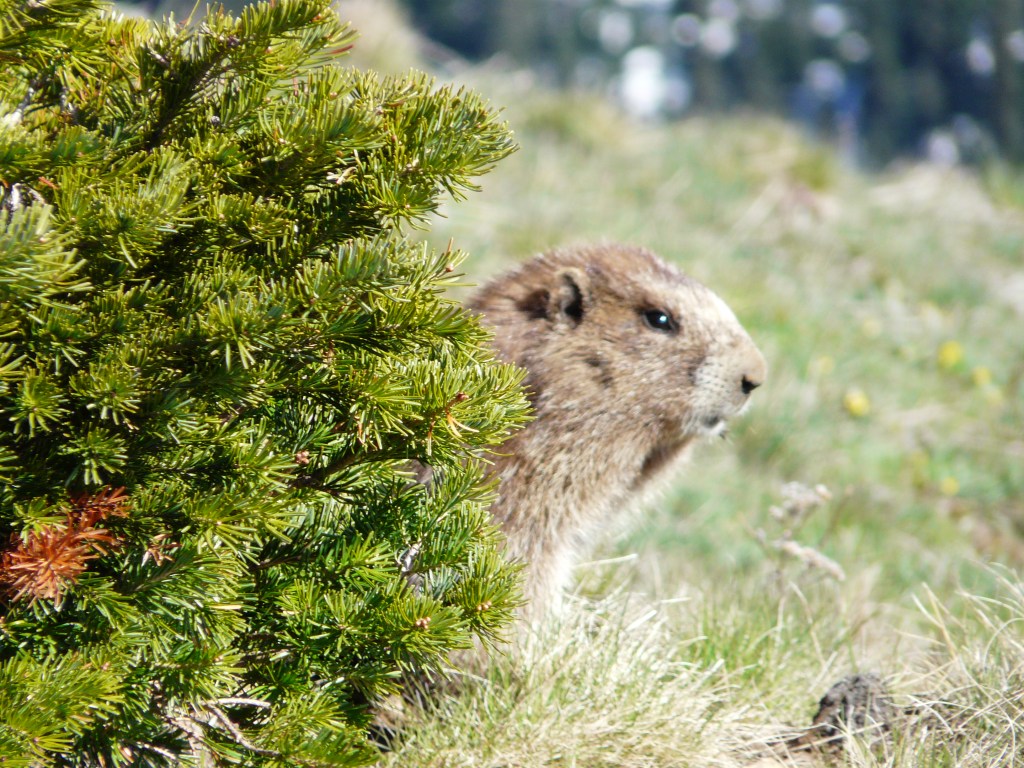
Then there were the animals. Some species were the same as those you might expect to encounter on other Northwest mountains–like the grey jays who followed us for a little while, or the black bear we spotted foraging for food in a valley below the trail. But one species of mammal in particular stood out: Olympic marmots. This large, adorable rodent is endemic to the Olympic Peninsula, and as I’d never seen them before I rather hoped we might encounter one. My hope was more than rewarded: the marmots of Hurricane Hill are clearly very accustomed to people, and we got close to several who came right up to the edge of the trail.

Despite having such a limited range, Olympic marmots have not traditionally been classified as an endangered species, mainly because their habitat lies almost entirely within the protected national park. However, as with so many other alpine species, climate change could complicate their odds of survival. As we progressed to the top of Hurricane Hill, it occured to me how easily this island of alpine environment could sink beneath a sea of trees if the local climate continues to warm. The survival of Olympic marmots, and so many other alpine species in the Northwest, likely depends on how much we can limit the buildup of carbon in the atmosphere.
On a lighter note, I was also excited to spot a few horned larks flitting over the alpine meadows. This bird species may not be particularly rare, but I hadn’t often seen them and was pleased to get a good look through my binoculars. Horned larks normally eschew forested areas, frequenting open meadows like those found in the alpine.
From the top of Hurricane Hill you could see Olympic Mountain peaks extending as far as the eye can see in one direction, with a stunning view of the Salish Sea in the other. We gazed out at the San Juan Islands far below, and I was reminded of how lucky we are to live in such an exquisitely beautiful part of the world.
In closing, I would say if you want to experience the unique alpine environment of the Olympic Mountains yourself, Hurricane Ridge is a great place to start. And especially be sure to keep an eye out for marmots.
 Nick Engelfried
Leave a comment