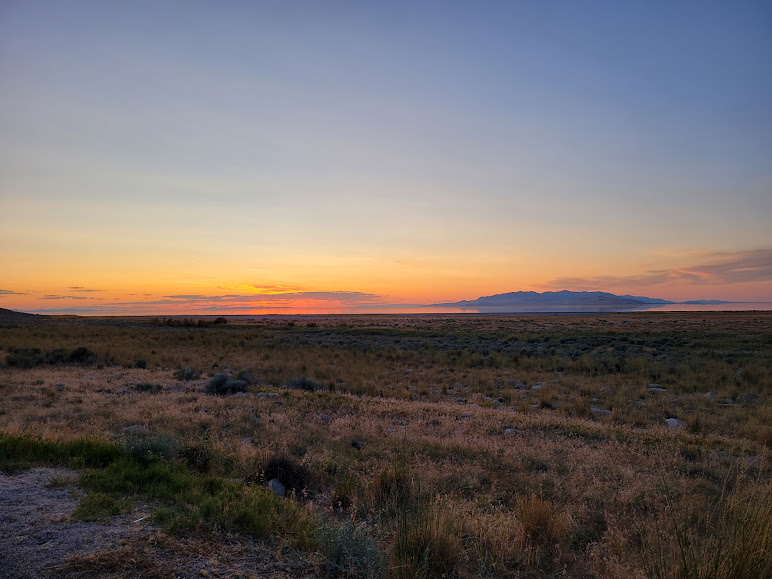


When the sun begins to set over Utah’s Great Salt Lake, the sagebrush steppe on Antelope Island seems to come alive with wildlife. Jackrabbits and desert cottontails emerge from hiding to feed in the cool of evening, while pronghorns and deer graze on shrubs. Crickets chirp and moths and lacewings take to the air. Then there are the predators: coyotes, snakes, and burrowing owls that come out to hunt at dusk.
I had the opportunity to experience all this recently while camping for three nights on Antelope Island, the largest island in the Great Salt Lake. I was in northern Utah to experience and learn more about the unique ecosystems in this part of the country, and this island with a storied history was my first stop.
Antelope Island has been used by humans since time immemorial. Local Indigenous peoples would have used it as a hunting ground for millennia before the first Mormon settlers showed up in the region. When the colonists did arrive, they grazed cattle and sheep on the island (apparently Brigham Young himself had livestock there). However, with its exceedingly dry environment, Antelope Island was never very well suited to support agriculture on a large scale. Today, it is a state park managed mainly for wildlife conservation and recreation.
I always enjoy low-tech, low-carbon travel when possible, and I biked out to the island after arriving in Salt Lake City via Amtrak train. Below are some highlights of my experience there, which was mainly focused on viewing wildlife. If you’re planning your own trip to the area, you might consider a similar itinerary!

1. Biking to the Island
I got off Amtrak in Salt Lake City with my bike, then got on the local intercity train to the small town of Layton, where I disembarked and loaded up my bike with supplies I’d brought with me and plenty of water. From there, it would be about a 19-mile bike ride to Bridger Bay Campground on the island, where I’d be spending the next few nights.
The highlight of the ride was crossing the approximately 7-mile-long causeway that connects Antelope Island to the mainland. It’s a wonderful place from which to spot wildlife, especially birds, and I made some stops to view flocks of white-faced ibises, American avocets, willets, and other species through my binoculars. I knew I’d be returning to this spot for more birding soon.
I arrived at Bridger Bay by early afternoon, found my reserved campsite, and set up camp. The day was growing hot and I largely waited out the most sizzling hours of afternoon at the campsite, which afforded its own wildlife viewing opportunities. I’d heard Antelope Island is home to impressive numbers of not just birds and mammals, but spiders, and the rumors turned out to be completely true. Soon, I was watching as this wasp attacked and paralyzed this large wolf spider:
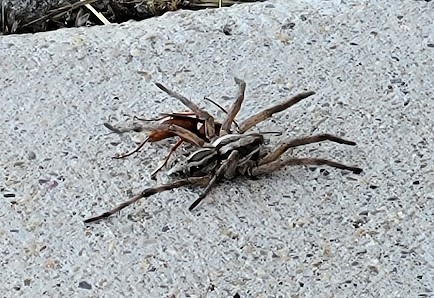
The wasp carried the spider off, presumably to a burrow where its larvae will feed on the arachnid’s paralyzed body. While feeling some sympathy for the spider, I couldn’t help appreciating the chance to see this natural drama in action.
That evening, I took a walk around the campground and observed the wildlife coming out at dusk. I was particularly excited to see a pair of burrowing owls perched on the upper branches of a couple of shrub. I suspect they had a burrow nearby and didn’t want to scare them, so I didn’t get too close.
2. Bike to Garr Ranch
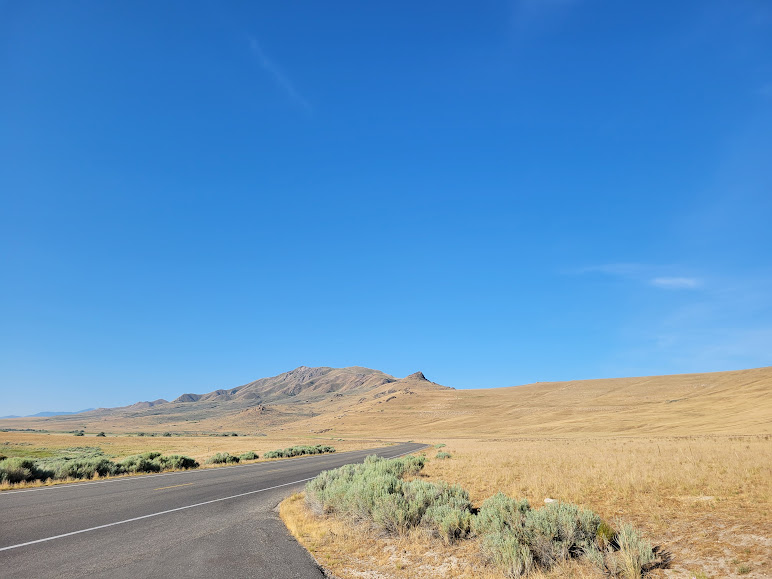
If your goal is to see wildlife, the historic Fielding Garr Ranch is one of the best places to go on the island. On my second day, I left early before the morning started to grow hot, and headed out on my bike for this spot. It was an approximately 12.5 mile ride to the ranch, along a road with beautiful views of the Great Salt Lake’s Farmington Bay on one side, and the dry, scrub-covered hills of the island on the other. I saw numerous birds including meadowlarks, a chukar, and more burrowing owls.
Garr Ranch is at the site of one of Antelope Island’s natural springs, which not only served as a source of fresh water for ranch operations in former times, but also produces lush plant growth and draws animals to drink and forage–including the island’s famous bison herd.
The Antelope Island bison were brought to the island in the 1890s, as a time when bison as a species seemed in imminent danger of going extinct. Whether they count as a truly “native” species is an interesting question. It seems entirely possible that, in precolonial times, bison would have occasionally wandered onto the island across the land bridge that periodically connects it to the mainland when the Great Salt Lake’s water levels are low. However, this part of Utah was never at the heart of the bison’s range, and their visits would likely have been infrequent. Regardless, today several hundred semi-wild bison call the island home.

At Garr Ranch I explored the grove of trees around the spring and the historic ranch house and corrals that are now maintained by Utah State Parks. Wildlife viewing is always a hit-or-miss affair, and I wasn’t sure I’d get to see the Antelope Island bison–but just as I was getting ready to leave, I spotted a herd up on the hills. They were far away, but through my binoculars I got a good look. Here’s a photo of them making their way across the steppe landscape:
3. Visit the Salt Lake

A trip to Antelope Island wouldn’t be complete without visiting the waters of the Great Salt Lake itself, and that evening I set out to do just that. The lake’s water levels this year are very low, so it was a bit of a walk to get down to where water meets land. Though fluctuations in water level have always been part of the lake’s ecology, recently years with extremely low water have become increasingly common, largely because much water that naturally flows into Great Salt Lake from streams is diverted for irrigation and cities.
When I reached the water’s edge, I found the beach covered (as in, literally covered in places) with tiny brine flies, which rose up from the sand in waves as I approached. Brine flies are an essential part of the Great Salt Lake food web and are completely harmless to people, so they didn’t bother me one bit. I waded into the lake shallows and walked through the water along the edge of the bay as the sun sank low in the sky and tiny brine fly larvae and brine shrimp swirled around my ankles. Brine flies and brine shrimp are two of the few invertebrates that can survive the lake’s high salinity, and provide the basis of the food chain that supports thousands of migratory birds every year.
Wading in the lake was a simple exercise, but it was one of the most magical moments of the trip for me. I returned to my campsite as the sun sank behind the hills and darkness descended.
4. Go Birding on the Causeway

For my third day on Antelope Island, I returned to the Causeway, biking to the end of it and back as I made frequent stop to scan for birds. I saw hundreds more ibises, avocets, and willet–all wading birds who enjoy searching for food along the shoreline or in marshy waters near the lake’s edge. Other species I spotted included white pelicans, eared grebes, black-necked stilts, a shrike, and ring-billed, California, and Franklin’s gulls. I highlight of the outing was when I sighted a couple of long-billed curlews picking their way through the wetland grasses. The remarkably long beaks of these birds look almost unreal, like a cartoon drawing.
The Great Salt Lake is one of the most important bird habitats in the Western United States, serving as an oasis of food and shelter in the otherwise arid landscape. For example, up to 20 percent of the continent’s white pelicans nest on the lake, mainly on Gunnison Island. Historically, the island has served as a sanctuary where pelicans can raise their young protected from predators. However, low lake levels in recent years have allowed predatory animals to reach the island, causing havoc for nesting pelicans.
My birding expedition on the causeway was a reminder of how important the salt lake is for many bird species, and of how water diversion schemes now threaten its ability to continue serving this vital function.
5. Explore the Lakeside Trail
On my last evening on Antelope Island I hiked the Lakeside Trail, a 2.8 mile path that starts by Bridger Bay Campground, snakes along the edges of Buffalo Point, and ends up near White Rock Bay Campground. By connecting with other trails, it’s possible to turn a traverse of this trail into 5-mile or so loop that ends up back at Bridger Bay.
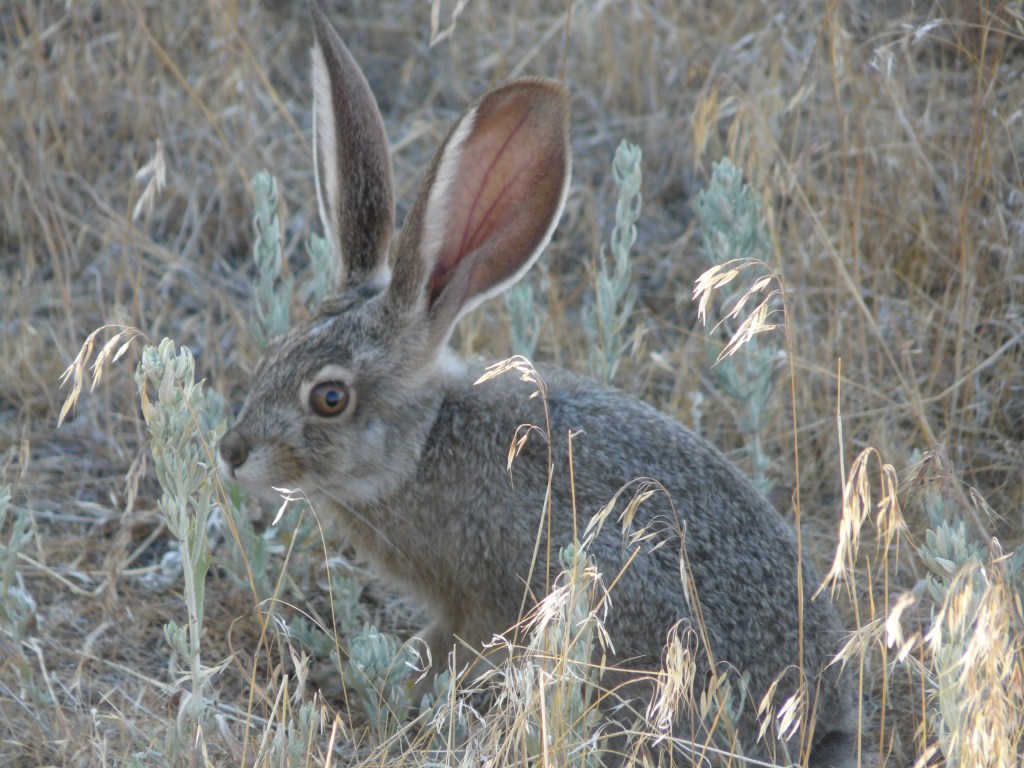
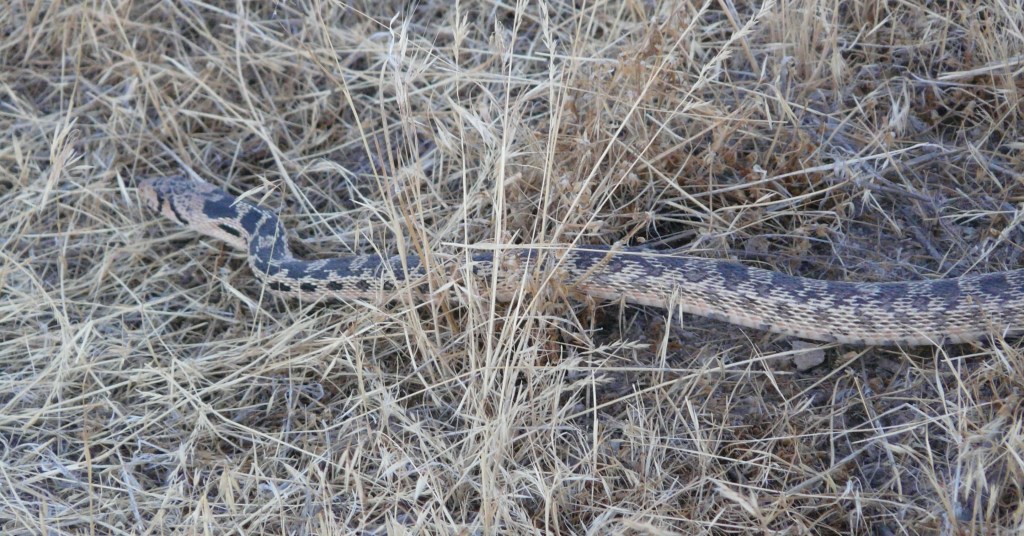
On this short hike I encountered many of the wildlife species I’d come to know over the last few days, including burrowing owls, jackrabbits, and cottontails. I also spotted a coyote prowling along the water’s edge, and later listened to it howling back and forth to another individual who I could hear in the distance. As the evening began to cool off, I also came across an animal I’d never encountered in the wild before: a gopher snake slithering along the edge of the trail. The snake froze when it sensed my presence, then slowly began moving again once it determined I wasn’t a threat.
Conclusion
If you are hoping to see a spectrum of the amazing wildlife viewing opportunities the Great Salt Lake has to offer, Antelope Island is a great place to go. You can certainly visit this place by car–but I highly recommend biking if you have the opportunity, as you’ll get a more immersive experience that way. Just be sure to bring plenty of water. During my time on the island, running water at the campgrounds was shut off, so I carried lots of water with me the whole time.
Antelope Island is also a good place to be reminded of the challenges facing wildlife and wild lands throughout the West. As I was exploring this place, I was all too aware that members of the US Senate were debating the largest public lands selloff in US history, spearheaded by non other than Utah Senator Mike Lee. That amendment fortunately didn’t make it into the massive bill which was eventually passed by the Senate and signed into law by President Trump–but many other terrible things did. These included a massive rollback of the only major climate legislation ever passed in this country, meaning we are now essentially back at square one when it comes to addressing the climate crisis.
As the West dries with climate change, policymakers will be under even more pressure to divert water for irrigation that would otherwise flow into the Great Salt Lake. The balance of this entire ecosystem is therefore in real jeopardy, even though places like Antelope Island are on protected land. I hope everyone who visits this unique place comes away inspired to engage with your elected representatives and advocate for policies curb carbon emissions, protect public lands, and conserve our precious water supplies.
As for me, after three nights on Antelope Island I biked back to the mainland and prepared to embark on the second part of my trip in northern Utah: a visit to the renowned High Uintas Wilderness Area. Check back here soon for a report on that expedition, and how to make the most of a visit to High Uintas should you go yourself!
 Nick Engelfried
Leave a comment