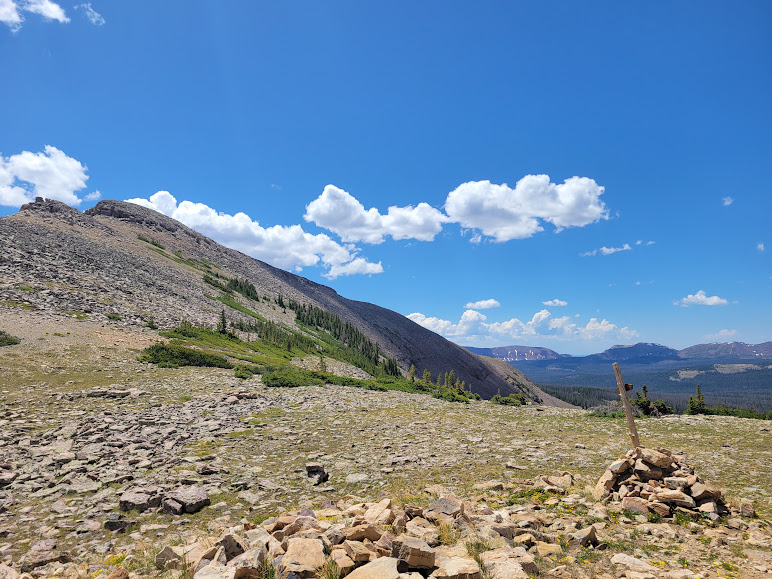


Look out at the seemingly endless mountain peaks from Rocky Seas Pass in High Uintas Wilderness, and it’s easy to sense that you’re in one of the most extensive, relatively pristine wild landscapes left in the contiguous United States. That’s what I found myself thinking during a recent visit to this special spot, at any rate.
At the end of my recent post about Antelope Island, I promised to return with a post about the next stop on my recent trip to Utah: High Uintas Wilderness. Established in 1984, this protected area covers over 450,000 acres and is by far the largest wilderness area in the state. It’s also widely considered one of the premier wilderness areas in the entire Lower 48. Given all this, I knew I had to make it out there, even if just for a couple nights.
Below are some highlights from my experience in High Uintas, which you might consider incorporating into a trip should you be fortunate enough to go there:
1. Camping at Naturalist Basin
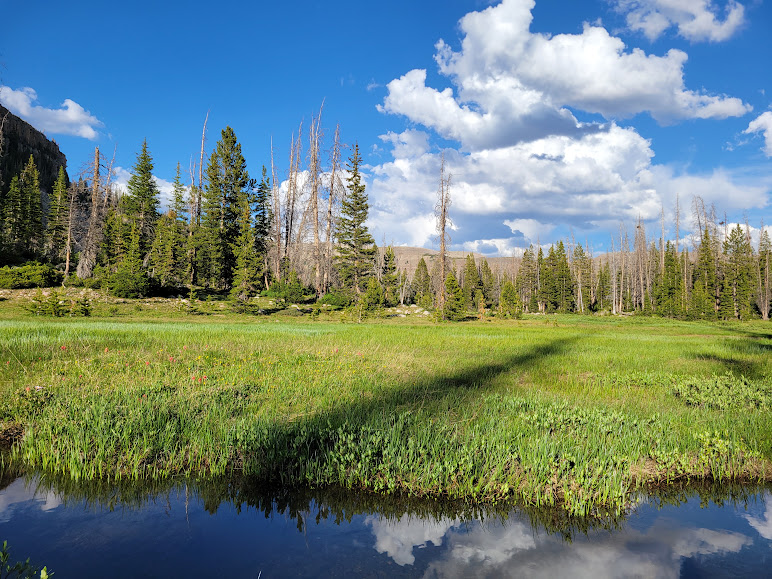
On the first day of the trip, I rented a car and drove to the Hayden Pass Trailhead, where I started down the High Line Trail. The forest, dominated by a mix of Engelmann spruce and lodgepole pine, was greener than I expected, with many wildflowers in bloom. Flowers that I saw included bluebells, columbine, paintbrush, and shooting star. Soon, I reached the official Wilderness Area boundary and passed into the protected part of the Uintas.
I camped that night at Naturalist Basin, a beautiful spot that’s popular with hikers and backpackers. Despite this popularity, I saw only one other person there. As the sun sank in the sky, I watched grey jays in the tree branches and gazed out at the massive cliffs rising around the basin. I’d definitely camp there again if given the chance.
2. Hiking to Rocky Seas Pass
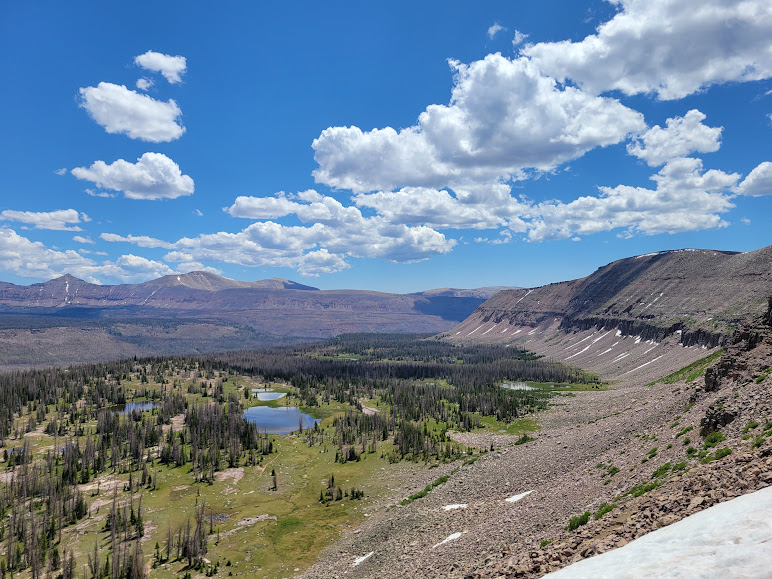
The next day, I left Naturalist Basin and hiked to Rocky Seas Pass, with the plan of camping either in Rock Creek Basin on the other side of the pass, or in nearby Four Lakes Basin if the trail to the former spot turned out to be impassable from snow. As I hiked deeper in the Wilderness Area it seemed to grow more and more beautiful, with sunny open meadows and additional abundant wildflowers. Along the way, I made a quick side trip to visit Lake Carolyn.
I eventually reached Pigeon Milk Creek, a silty stream whose crossing almost perfectly coincides with the point where the trail starts a steep uphill climb for the last mile or so up to Rocky Seas Pass itself.
As I climbed upward, the forest of spruces, pines, and the occasional subalpine fir gave way to the tundra-like ecosystem that exists above the treeline. Small blueberry bushes grew close to the ground, while colorful lichens adorned large boulders. I was in a bit of a hurry, as tall clouds were moving in and I didn’t want to be caught on the pass in a lightning storm. However, I suspected the view at the top would make the climb worth it–and I was most definitely correct about this.
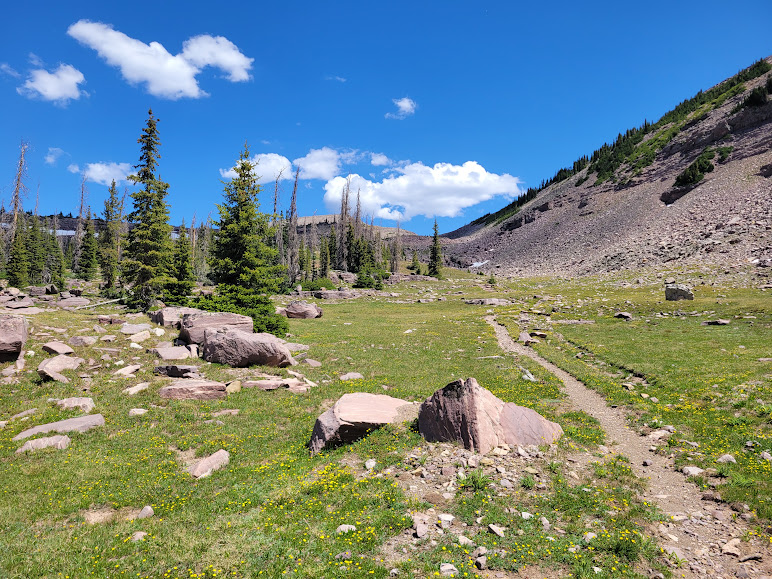
The view from the top of Rocky Seas Pass was one of the most beautiful I have ever encountered, and can’t adequately be described in words. As I climbed up to the top of the pass, I looked down into Rock Creek Basin at a forested landscape punctuated by open meadows and alpine lakes, enclosed by layer upon layer of mountain peaks stretching into the distance. There was not another human being in sight, and it felt like one of the most remote areas I’ve encountered in my many years of backpacking.
As it turned out, there was snow over the trail on the other side of the pass, making it unsafe to traverse, so I headed back down the way I had come with the aim of camping at Four Lakes Basin, the turnoff to which I had seen on my way to the pass.
Camping in Four Lakes Basin
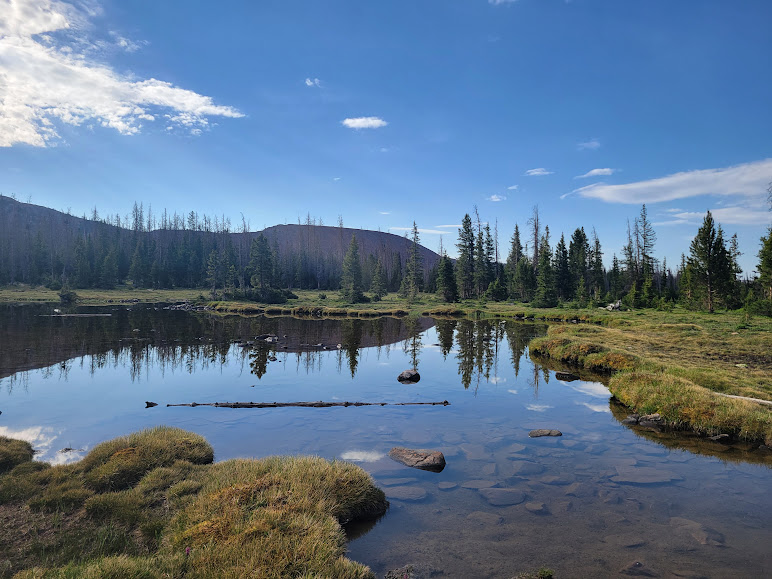
Four Lakes Basin was yet another exquisitely beautiful spot, with a series of large alpine lakes enclosed within a valley bowl. Once again, I saw no one else there. In fact, while I did pass some other hikers on the trail, overall I saw very few people during my time in High Uintas. I walked through a boggy meadow where small violets, elephant’s head, and marsh marigolds grew in abundance, and made camp at the edge of an island of trees. Thunder was rumbling in the distance by this time, and I set up my tent before the storm arrived.
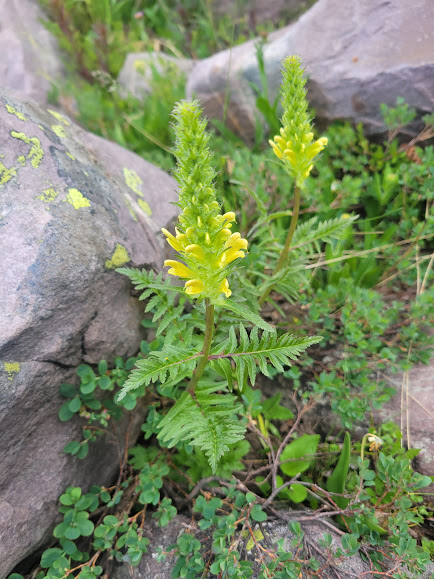
After the storm passed, there was still enough sunlight to go swimming in the lake, and that night I heard a screech owl calling as I lay in my tent. The next morning, I documented more flowers in the meadow, including this bracted lousewort:
Later that morning, I hiked back to Hayden Pass via the High Line Trail, concluding my time in High Uintas Wilderness. The trip to this special spot was incredible, and I definitely recommend it if you’re looking for a remote, primitive wilderness experience in a place where you’re unlikely to see many other people.
An Almost Perfect “Wilderness”
High Uintas Wilderness is one of the best places in the Lower 48 to experience a vast wild landscape that looks as if it it’s been largely unchanged since before colonization of North American continent by Europeans. That said, like wildernesses everywhere, even this special spot has not escaped being impacted by our modern civilization.
When the Wilderness Area was established in 1984, it must have seemed as if its protected status would guarantee the health of the ecosystem forever. However, we’ve now known for decades how climate change is affecting even the most remote parts of the globe. More recently, High Uintas was one of several remote areas studied by researchers seeking to understand how microplastics end up in the wilderness. Microscopic plastic particles were found in abundance even in this apparently pristine spot–something that was on my mind as I hiked through it.
To actually protect High Uintas Wilderness and places like it in perpetuity, we need to change how our society operates closer to home. If you’re looking for ways to help, check out this list of ways to get started taking action on climate change.
 Nick Engelfried
Leave a comment