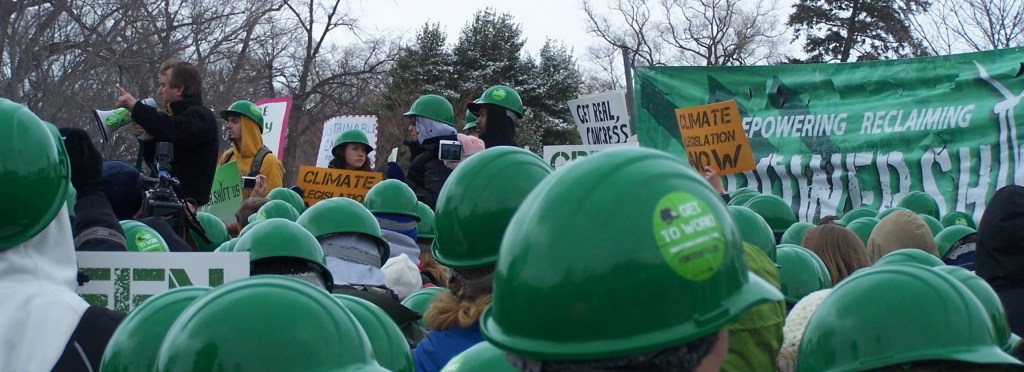


My senior year of college, I traveled to Washington, DC with three other students from the small liberal arts university in Oregon where I went to school. It was 2009, and we were in the nation’s capital for Power Shift, a gathering of over ten thousand students from across the country who converged for a weekend summit focused on the biggest planetary crisis of our time.
Friday through Sunday we participated in workshops, panels, and training sessions on everything from how to talk to elected officials to the science of greenhouse gases. We heard from keynote speakers including renowned climate activist Bill McKibben, EPA head Lisa Jackson, and civil rights organizer Van Jones. And on Monday, we met with our members of Congress during a lobby day on Capitol Hill.
We were, the speakers and workshop leaders told us repeatedly, the generation who would stop climate change — or “global warming,” as we called it then. We Millennials were the largest generation in US history. We had more sophisticated technology in our cell phones than Neil Armstrong brought to the moon. And we were an overwhelmingly progressive generation who helped elect the country’s first Black president.
It seemed to me if any generation could save the planet, it would be us. Besides, given the stakes, the cost of failure was just too high. We couldn’t afford not to succeed.
Was I hopelessly naïve? Maybe. Either way, here we are in 2026, and the climate crisis is definitely not solved. The icecaps are still melting, deadly heat waves are a summer norm, and every year huge parts of North America are blanketed in smoke from massive wildfires. So, what went wrong?
It would be easy to blame my generation for failing to live up to our potential. But some of us tried very, very hard to avert the catastrophe we saw bearing down on us from the ’00s.
The year of Power Shift, I graduated into a recession. I had trouble finding a job in my field, so I moved back in with my parents and began volunteering with the Sierra Club on a campaign to close Oregon’s only coal-fired power plant. I recruited local college students to testify at public hearings that would help decide the plant’s fate. Every time one of the young people I’d worked with got up to testify, I had the visceral feeling my generation was coming through for the Earth.
After a couple years I went back to school to earn a master’s in environmental studies from the University of Montana. There, I engaged in more climate activism — including involving UM students in work to oppose a massive new mine Arch Coal wanted to build in the state. We held rallies, got our City Council to pass resolutions, and signed local businesses onto a letter opposing the mine. I even got arrested at protests a couple of times.
I don’t doubt at least some of the activism I was involved with in Missoula helped advance the movement against the fossil fuel industry. In early 2016, Arch Coal shuttered its Montana office and walked away from the mine project. It felt like a remarkable grassroots victory.
Indeed, if there’s one thing I learned from my sojourns in climate activism, it’s grassroots organizing does have an impact. Don’t let cynics tell you smallish groups of people with no budget and little professional training can’t make a difference. I’ve seen it happen again and again.
The coal plant in Oregon my colleagues at the Sierra Club were fighting is closed now, too, part of an unprecedented wave of coal plant retirements that began in the ’10s and continues today. Meanwhile, countless state and local governments have committed to reducing carbon emissions. Universities, foundations, and other entities have divested trillions of dollars from the fossil fuel industry. All these victories came about thanks to the hard work of ordinary people.
So, the efforts of myself and other Millennial climate activists weren’t in vain. We accomplished things — just not enough. Because, although the fossil fuel industry has suffered many defeats, coal, oil, and gas still generate around 80 percent of US energy. More to the point: almost every year since I learned about the climate crisis, the concentration of greenhouse gases in the atmosphere has ticked steadily up.
I no longer consider myself an activist first and foremost. The pace with which I took on new projects in the early ’10s was unsustainable, and in 2016 I returned to school again to pursue an M.Ed. in environmental education. I came to think of myself primarily as an educator and writer. Meanwhile, the baton of “generation who’s supposed to solve the climate crisis” has been passed.
In 2019 and the early ’20s, as I leaned more into my writer identity, I began covering extensively the inspiring climate activism of Gen Z. From the Fridays for Future climate strikes to popularizing the concept of a Green New Deal, this new generation of activists seemed to be shifting the politics of climate change in ways we Millennials never quite managed.
This work paid off in 2022 when Congress passed the first major national climate legislation in US history, a suite of clean energy tax incentives and grant programs embedded in the Inflation Reduction Act. Perhaps it was too little, too late — but for a brief moment, it felt like we were really getting somewhere.
Of course, anyone who’s been paying attention knows what happened next. In 2024, US voters in their wisdom chose to reinstall the most anti-climate president in history, who last year stood in front of the United Nations and declared climate change a “con job.”
I’m sure most diplomats at the UN laughed off that speech. More damaging is how the second Trump administration has moved to dismantle basically every federal program focused on combating the climate crisis. Those clean energy tax incentives in the Inflation Reduction Act? They’re gone now. In fact, federal US climate action (or non-action) has basically reverted to something resembling the condition it was in when I was a college freshman.
It’s more complicated than this, of course. Many US states still have their own strong climate policies. Despite his worst efforts, Donald Trump won’t be able to halt the coal industry’s irreversible decline or the growth of clean energy. Also, while the IRA’s tax incentives are being discontinued, there’s reason to think the law cemented a new baseline for climate action that future presidents and Congress will feel obligated to return to. Still, there’s no denying the setbacks.
Last year I visited the California redwoods. Walking among the centuries-old trees in Humboldt Redwoods State Park, it was painful to reflect these ancient giants might not be able to withstand what’s ahead. A specialized plant, redwoods thrive in the environment created by ocean currents that cloak the northern California coast in cool fog every summer. With climate change disrupting these weather systems, the trees may not be able to adapt.
I tell myself there’s still hope. After all, while progress stalls in the US, the rest of the world is moving full steam ahead toward a low-carbon future. In the first six months of 2025, China alone installed an amazing 267 gigawatts of clean energy, with many analysts predicting this will soon lead global carbon emissions into a downward trajectory. The problem is, so far it’s still not happening at anywhere near the rate scientists say we need to avert some of the worst climate change impacts.
I’m convinced that, viewed from the era my parents grew up in, the climate-scorched world we now inhabit would already qualify as a dystopia. This is what all of us at Power Shift in 2009 tried to avoid, and we failed at that. You could always say it’s because we weren’t committed enough, didn’t try hard enough, didn’t make big enough sacrifices. But I think there’s more to it.
As a college student I felt burdened with an overwhelming need to prove my generation’s worth. I’m not sure where this came from — reading Thomas Friedman op-eds about the shortcomings of Millennials, maybe — but it guided my decisions well into my twenties. If Millennials, as a collective, failed to stop the climate crisis, I felt it would reflect a personal failing on my part.
Obviously, that’s ridiculous. No individual is responsible for their whole generation’s actions, and Millennials like other generations are a mixed bag. Some of us tried very hard to address the crises we saw around us. Others went about our lives, oblivious.
It’s the same with Gen Z. I’ve written a lot — and will probably write more — about the inspiring activism of students who started the climate strikes and sat-in for a Green New Deal. I truly believe Gen Z includes some of the savviest, most effective activists in history, who’ve achieved a lot for the climate. But to paint all or even most of them as progressive climate warriors would be wrong.
Members of Gen Z helped pass the most groundbreaking climate legislation in US history, but collectively their generation failed to defend it at the ballot box. An outpouring of support for pro-climate candidates from young voters probably could have tipped the scales in the 2024 election, but this wave didn’t materialize. Of those members of Gen Z who bothered to vote at all, only around 52 percent chose Kamala Harris — the smallest margin of young voters in years to support the Democratic candidate for president.
Gen Z climate activists shouldn’t be blamed for this, any more than I and other activists my age bear responsibility for those Millennials who didn’t do much to stop climate change. In fact, I’m starting to think the whole idea of assigning responsibility for rescuing the planet to a particular generation was flawed to begin with.
To the extent we’ve made some progress in the climate fight, it’s because of people of all ages coming together. Some of the most inspiring activism I’ve witnessed has come from people in their fifties, sixties, and seventies marching in the streets, haranguing their elected officials, and — in some cases — sitting down to be arrested.
I feel a certain wistfulness whenever I read about young people who threw caution to wind to pursue youthful dreams, whether traveling the world or throwing themselves into artistic endeavors. I never allowed myself that kind of freedom because I felt such a pressing responsibility to fight for a better world. There are moments when I wonder if the sacrifice was worth it.
Occasional doubts aside, though, I don’t regret the energy I devoted to climate activism as a young person. I’d feel worse if I didn’t think I had done just about all I could to attack the climate problem. Today, being older and slightly wiser, I try to help in ways that are more personally sustainable. My manner of being involved may have changed, but I still feel an imperative to contribute, even if largely by writing about the issue.
I refuse to be one of those adults who look at the planetary situation we’ve collectively created, shrug our shoulders, and comment that now it’s up to younger people to fix the problem. This endless passing of the buck has to stop, and it’s not any generation’s singular responsibility to dig us out of the hole we’re in.
I wish I could end with a pithy summation of what it means to fight for a better future at this juncture in time, or concrete advice for others struggling to come to terms with the successes and failures of fifteen-plus years of climate organizing. I have nothing like this to offer, though. All I can say is now more than ever, we need everyone’s help righting this ship regardless of the generation you belong to.
We Millennials didn’t stop the climate crisis by ourselves. But maybe we were never really supposed to.
 Nick Engelfried
Leave a comment