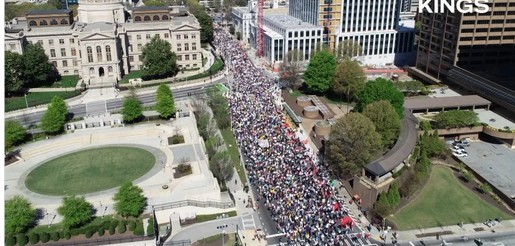


Photo credit: No Kings Day 3 protest in Atlanta, GA. Credit: Bluesky/50501
Just over a week ago, we witnessed what many people are calling the largest single-day protest in US history. At least eight million people — more by some counts — swarmed into the streets to protest the Trump administration’s attacks on democracy, common decency, and so much more on No Kings Day 3.
The No Kings movement has become core to the resistance during Trump’s second term. It has now organized three major protest days, each more impressive than the last, and has helped demonstrate conclusively that the American public is fed up with Trump. Yet, in the weeks ahead you’re likely to hear people asking this question: What has all this protesting accomplished? The assumptions implied by the question itself suggest those asking it don’t have a very clear idea of how protest really works.
Most people assume that if protests are effective, we should be able to see a direct cause-and-effect link between large protests, and policy change. It’s no surprise we tend to see protests this way. When we hear about big social movements from the past — where in movies, popular books, or even sometimes in school — the emphasis tends to be iconic moments (think the 1963 March on Washington), and the legislation or other policy changes that followed. We’re left with the impression that in each of these past examples of social change, people somehow came together for a massive protest, and the effect was so impressive that it compelled or inspired decision makers to take action in accordance with public opinion. But that’s not how it actually works.
In reality, almost every successful protest is part of a much larger movement that involves many tactics, some of them unfolding in the open and others occurring behind the scenes. The March on Washington was a big deal for the Civil Rights Movement of the 1960s — but it was just one part of that movement. Lost in romanticized accounts of the Civil Rights era are the countless meetings, trainings, petition campaigns, and frustrating interactions with elected officials that accompanied the big, iconic protests. It was all of these tactics working in concert that led to passage of the 1964 Civil Rights Act and the 1965 Voting Rights Act.
When you don’t understand what the process of social change actually entails, it’s easy to get discouraged when a big protest isn’t immediately followed by substantial policy change. It can seem like the protest had no real impact — hence that question about what all the No Kings Day activists accomplished. But these protests do accomplish something very important when they’re embedded with other tactics, as the No Kings Day movement certainly is.
The modern resistance to Trump’s assault on democracy is unfolding on many levels. You have charismatic elected officials like Bernie Sanders and Alexandria Ocasio-Cortez calling out the administration in the halls of Congress. You have organizations fighting Trump’s illegal executive orders in court. You have campaigns targeting the CEOs and corporations who enable Trump’s mayhem. And, you have big protests. It will take all of these approaches working together to save democracy.
So, what exactly is the specific role of large protest in a social movement? What these big mobilizations do is show that a lot of people are paying attention to an issue and care enough about it to take meaningful action. There’s really no way to do this except through protest. Getting out in the streets (or some other public space) gets attention because it’s both highly visible, and requires effort on the part of those involved. This last part, though often overlooked, is key; the very fact that people are willing to step out of their day-to-day lives and march through the streets shows they don’t just care — they care enough about the issue at hand to inconvenience themselves. A petition, for example, can never do this in the same way. Signing your name to a petition is too easy; it shows you care about the cause, but not necessarily very much (this isn’t to say petitions are pointless, just that they serve a different purpose from protest).
Not every movement needs to rely on big protests. Especially if the issue you’re organizing around is local or directly affects a relatively small segment of the population, big street demonstrations may not be practical or necessary. However, any movement tackling big, national issues on which the population is starkly divided is going to need large protests to show it has momentum. This description certainly applies to the No Kings movement.
With this context in mind, let’s take a moment to appreciate what No Kings just did. Literally millions of people all over the country got out into the streets to protest the Trump administration’s actions. By some metrics, we’ve never seen this many people in the US protest on one day before (this sort of depends on how you define “protest,” though; Earth Day in 1970 involved some 20 million people and was even bigger than No Kings). Regardless of whether it was the biggest, or “just” one of the biggest protests in history, No Kings was a huge deal. It attracted more visible public support than almost any issue in US history, and that’s truly impressive.
Whether they’ll admit it or not, politicians at every level of government were watching what happened on No Kings Day 3. Those who have aligned themselves with the Trump administration got the message that a big chunk of the public is not on board with their actions, while progressive elected officials saw they have the backing of a mass movement when they stand up to Trump. That kind of thing has a real impact.
So, did No Kings accomplish anything? Absolutely. However, we’re not going to know how effective it really was until months or years in the future. Again, most protests don’t precipitate visible change right away; they help galvanize larger movements that effect change over time through a variety of tactics. To think that any one protest is going to make Trump’s regime collapse overnight isn’t realistic, and if we think that’s how protest is supposed to work then we’re going to prematurely judge every mobilization as a failure.
If you were at a No Kings Protest or support the larger movement it represents, now is the time to think about how you can help carry the momentum from this historic moment forward. Maybe this looks like volunteering for a Congressional campaign, participating in boycotts of Trump’s enablers, or getting involved in a local group working to fight back against the administration’s agenda. The important thing is to do something, and help ensure No Kings 3 really does represent a turning point in US politics.
 Nick Engelfried
Leave a comment