

The internet abounds with tips for how to do something about the climate crisis. From eating less meat to changing your lightbulbs, there’s no shortage of positive steps you can take–or at least, that’s the message being broadcast by countless blogs, articles, and social media accounts about sustainability. There’s just one problem: most of the advice floating around the interwebs is focused on reducing your personal carbon footprint. Yet, the most impactful things you can do for the climate have very little to do with minimizing your energy use, and a lot to do with changing the systems that make our economy so dependent on fossil fuels in the first place.
To be sure, it’s commendable to try to emit less carbon in your daily life. As anyone who has lived me with me could tell you, I spend a significant amount of mental energy fretting about the plastic content in the packaging on foods I buy, and trying to decide to if the thermostat is turned up unnecessarily high in winter. However, I try not to fool myself that these are the most important decisions I make related to combatting the climate crisis. The far more important question is what I’m doing to help influence policy and institutional decisions that can help or hinder the energy transition?
I’ve now been engaging in trying to do something about climate change for over a decade and a half, first as a fulltime activist and more recently as an educator and writer. I’ve seen plenty of groups and individuals make valiant efforts to help tip the scales away from fossil fuels, and conducted plenty of my own experiments–some more successful than others. Here are five of the most effective ways I’ve learned of leveraging your power as an agent of positive change for the climate.

Contact your elected representatives
This first item on this list is simple, but no less effective for that. In our age of memes and social media soundbites, it can be easy to forget how powerful the simple act of sitting down to write a personalized, thoughtful email can be. Writing such a message to your elected representatives is one of the most effective ways to let people who are making decisions on your behalf in the halls of government know what your priorities are. Your message will be most impactful if you do the following:
- Be polite. Whether writing to your member of Congress, state legislator, or local city council member, address them by their formal title (“Dear Representative ___”) and be respectful. While it may be tempting to vent frustrations at your representative, especially if they’ve done something that angers you, the truth is this will just make them less likely to listen to what you have to say. On this note, don’t threaten not to vote for them if they refuse to do what you ask: this is considered tacky, and is also unnecessary since it’s implied that you’ll be less likely to vote for them if they don’t support issues you care about.
- State in your own words why this issue matters to you. There can be a natural tendency when writing to an elected official to spout facts and statistics that show just how well-versed you are on the topic at hand. There is certainly nothing wrong with highlighting a few well-chosen numbers, but what’s far more powerful is to explain why the issue of climate change matters to you personally. Have you observed effects of extreme weather in your community? Are you directly impacted by fossil fuel development or pollution? Or are you simply worried about the world today’s young people will inherit? The one piece of information you hold that your representatives can’t get anywhere else is why this issue matter so much to you, a voter in their district.
- Be concise. While you likely have lots to say about your issue, make your message no longer than one double-sided standard-sized page (even if you’re composing it as an email). This will increase the chances of your message being read in full.
- Clearly state what you want your representative to do. This may sound obvious, but it’s extremely important that you be explicit about what action you want the person you are addressing to take. Be as specific as possible about this. For example, if your state legislature is considering a climate-related bill you support, explicitly ask your representative to vote for that piece of legislation. This is more effective than a more general call for them to support action on climate change (which can mean many different things to different people).
Your message will be much more effective if you take the time make it obviously personalized. This shows you care enough about the issue, and are knowledgable enough about it, to have sat down and written out a thoughtful request for your representative. Many advocacy organizations will supply you with pre-written templates for emails to send to your officials, and sending one of these is better than doing nothing. However, it’s much less powerful than writing a message in your own words (this is true even if your personalized message ends up being shorter).
As far as how to send your message: while it was once considered best practice to mail a physical letter, these days it’s just as effective to email your representative, and doing so guarantees your message will get through in a more timely manner. You can easily find out who your federal, state, and local representatives are using a tool like this, and every elected official should have contact information posted on their website. Sometimes this will be an email address, while in other cases they’ll provide a contact form to fill out.
Finally, if you don’t have time to write out a message, you can always pick up the phone and call your representative’s office. Calling and leaving a short message with a staff member or voicemail takes only a few minutes, and in fact may leave an even bigger impression than emailing.

Attend a rally or protest
Contacting your elected representatives is important, but so is showing up in a visible way that helps bring the issue of climate change into the public light. One of the best ways to do this is through a rally or protest–especially if it’s well-timed and thoughtfully organized. The most strategic protests tend to be timely; they coincide with an important vote or decision over a piece of legislation or regulatory rulemaking. Effective protests also have a clear, unified demand that makes your message obvious both to the decision-maker you’re trying to influence, and to the public.
Below is a photo taken in Seattle in 2015, during mass protests in that city against Shell’s plan to drill for oil in deep Arctic waters. The kayak-paddling activists in the image are raising an easy-to-read banner with a clear message, with a Shell drilling vessel docked at the Port of Seattle in the background. The imagery tells a clear story (people are upset about Shell’s drilling plans), and the demand is clear–there’s even a URL onlookers can go to for more information. This is a good example of effective protest messaging.
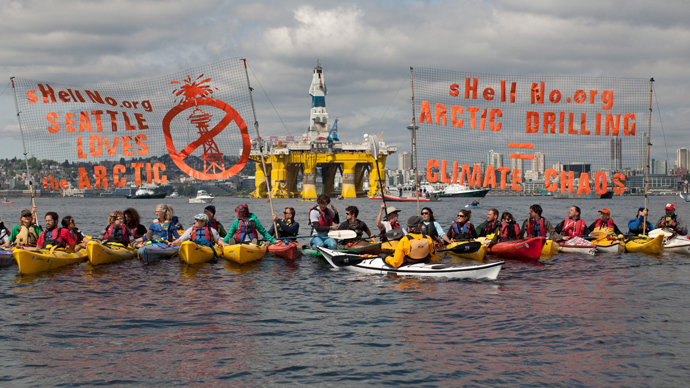
As shown by the example above, not all protests target elected officials. Sometimes you may be trying to influence the behavior of a corporation, and this too can be very strategic. Large companies hate to admit they let their behavior be influenced by activists, but make no mistake that highly visible protest targeting a corporation’s public image can produce results. Remember, most major companies spend literally millions of dollars each your carefully cultivating an image that’s meant to appeal to consumers, and they hate when that image gets tarnished.
The 2015 protests against Shell are a great example of how this kind of activism can be effective. While moving its drilling equipment up to Alaskan waters, Shell faced mass protests in Seattle, Portland, Bellingham, and other Northwest cities, which resulted in a wave of negative media attention for the company. Shell eventually made it up to the Arctic, only to quickly announce they had found less oil than hoped and were abandoning their deepwater drilling project. Did Shell really give up on a years-long, multibillion effort to exploit offshore Arctic oil because a few months’ worth of exploration yielded disappointing results–or was the negative publicity they were receiving a major factor in the decision? You can draw your own conclusions.

Attend a public hearing
In the U.S., any large energy project is mandated by law to go through a review process during which relevant agencies assess its likely environmental impacts and decide to grant it a permit to move forward, or not. Unfortunately, in the absence of much public attention on this process, many projects are basically rubber-stamped by federal or state agencies who tend to be sympathetic to industry. When an agency knows the public is watching their actions closely–and that large numbers of people are concerned about what their decision on a project means for the climate or local environment–they are much more likely to take any potential negative impacts seriously. This is why it’s so important to show up and voice your concerns during the review of energy projects near you, especially fossil fuel projects that hinder the energy transition.
Most large pieces of energy infrastructure, such as oil and gas pipelines, fossil fuel export facilities, or power plants, will be required to undergo a review process that results in an Environmental Impact Statement about the project in question. As part of this process the relevant agency will accept written comments from the public and hold public hearings where people can voice their concerns. Participating in these official comment periods is an effective way to help ensure a project gets the scrutiny it deserves. And while contributing a written commment is good, testifying in person at a hearing is even better, the reason being these events are often covered by local news and the in-person testimony helps shape the media narrative about environmental impacts of the project. That said, if you’re not able to testify, definitely don’t let that stop you submitting a written comment.
Of course, to participate in a public comment period, you have to know it’s happening–and the best way to do this is often to get on the email list of a local environmental organization that keeps an eye on these kinds of developments. For example, in the 2010s groups including the Sierra Club closely monitored a series of proposals for major fossil fuel export projects in the Pacific Northwest, turning hundreds or thousands of people out to public hearings. This organizing effort, combined with lawsuits from Indigenous nations and other types of activism, was incredibly effective. Most of the proposed coal, oil, and gas export projects eventually went down in defeat, never to be built.
Leverage your institutional power
Are you a college student? A member of a church congregation? Or do you work for a local business, nonprofit, or publicly funded entity? If so, you have power as someone who is part of that institution to help shift its practices to become more climate-friendly. There are multiple ways to do this:
- Push for sustainability actions. Advocate for your institution to reduce its own carbon footprint–which is almost certainly much bigger than an individual’s. If you’re a college student, get involved in efforts to help your campus use heat and electricity more efficiently or produce its own energy from renewable sources. Or, as an employee at a business or other entity, you may be able to suggest practices that reduce energy use while saving on heat or electric bills.
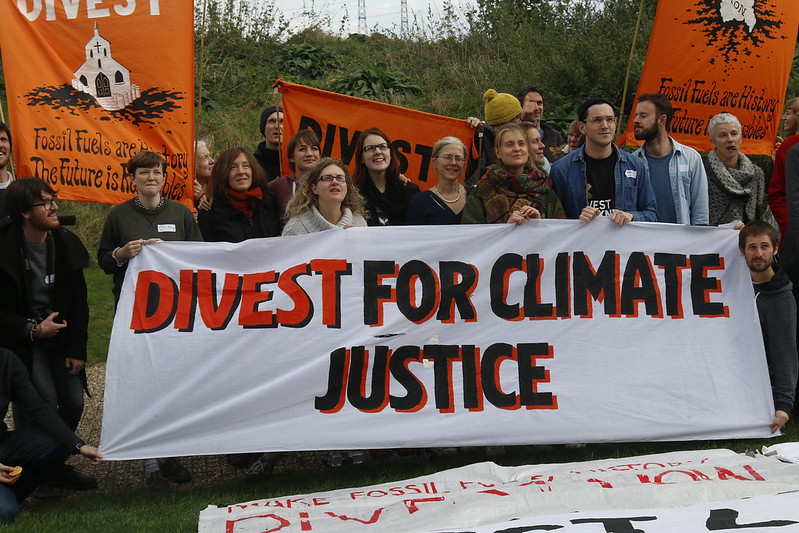
- Move your institution’s money. There’s a multitrillion dollar movement among higher education institutions, churches, foundations, nonprofits, and other entitities to divest their endowments or pension funds from fossil fuel companies and invest in more sustainable industries instead. While this type of divestment isn’t likely to directly impact fossil fuel companies’ bottom line (because it involves trading corporate stocks the company has already sold), it’s an effective way to undermine the industry’s public image by showing investors don’t approve of its actions.
- Take a public stand. Entities like small businesses and nonprofits can and do adopt public stances on a variety of issues affecting the climate, and you can advocate from within for your place of employment to be on the right side of history. For example, during a public comment period on a local fossil fuel infrastructure proposal, the business you are part of might raise concerns about health or safety impacts from the project. This can be a powerful way to shape the public narrative.
One good thing about advocating for local institutional change is it’s a way to have an impact that’s far larger than your individual carbon footprint, but effecting changes at this level is often easier than altering the behavior of a massive corporation or passing state or federal legislation. In some cases, it may not even be necessary to convince other people to implement change. For instance, if you’re an educator, you may have leeway to incorporate lessons about the energy transition and social change into your teaching, thereby using your institutional platform to make a positive difference for the climate. Be creative in thinking about where you have influence and how you might harness the opportunities available to you.

Join an organization
This one isn’t really a separate action, so much as a step that will help you more effectively accomplish all the others. Being part of an organization that agitates for institutional or policy change is one of the best ways to stay abreast of opportunities to advocate for legislation, show up at hearings, participate in a protest, or push your school or place of employment to change. If you are a college student, there’s likely an existing climate action organization on your campus–and if not, the time is ripe to start one! Those of us no longer in school may have the opportunity to get involved in a community organization, or the local chapter of a national group like the Sierra Club or 350.org.
Finding the right organization to get involved in can take time, and may involve going to meeting or events hosted by multiple groups to see which one feels like the right fit for you. Your level of engagement can also vary; most organizations desperately need people to come to meetings and help organize events, but if this isn’t something you have time to do you can still contribute by joining their email list and participating in opportunities for action when they arise.
Ideally, as you find an organization you feel good about engaging with and get more involved, you’ll move from the role of “activist” to that of “organizer.” The former is a person who leverages their own power to push for social change, while the latter is someone who helps empowers others to take action themselves. Confronting the root causes of the climate crisis is a massive project that requires the involvement of thousands of people–and that means one of the most important things you can do is recruit others to join the cause. By working in tandem to push for change at a higher level, each of us who cares about the climate crisis can have a far greater impact than by just limiting our personal carbon footprint.


Leave a Reply